
JuggerBot 3D Awarded $4 Million by Air Force to Develop Large Format Hybrid Additive System
The project focuses on advancing the ability to print a thermoset composite material that can transform the way an aircraft structure is designed, fabricated and sustained for limited-life aircraft.


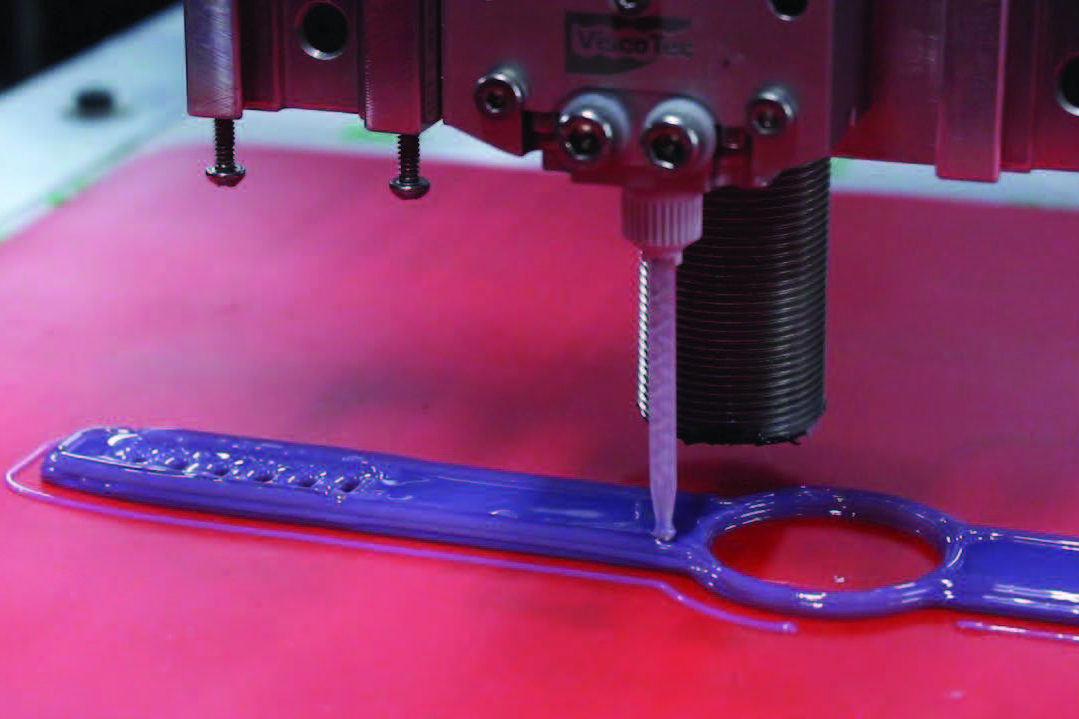
Juggerbot 3D’s Direct Ink Writing (DIW) Process. Source: Juggerbot 3D
Industrial 3D Printer OEM JuggerBot 3D has been awarded $4 million to produce a large-format hybrid material additive manufacturing (AM) system. The project is funded by the Office of the Under Secretary of Defense, Research and Engineering Manufacturing Technology (OSD(R&E)) and awarded by the Air Force Research Laboratory (AFRL).
The project is designed to drive technologies that will radically lower the cost of manufacturing, produce lighter weight vehicles and scale manufacturing to the speed of relevance. The overarching goal of this concentrated effort is to develop a state-of-the-art, hybrid, large-scale AM system that incorporates both two-part resin and pellet-fed material extrusion technologies, capable of processing both advanced thermoset polymers and performance-grade thermoplastic materials.


A member of America Makes, JuggerBot 3D will collaborate with the Institute, which works to accelerate the adoption of AM and advance the nation’s global manufacturing competitiveness.
A critical line of effort to achieve the goals of the project is the maturation of composite AM, particularly with high-temperature structural epoxies and other engineered thermoset resin materials in combination with thermoplastic resins. Advances in the ability to print a thermoset composite material can transform the way aircraft structure is designed, fabricated and sustained for limited-life aircraft.
“The Institute is proud to partner with JuggerBot on this effort,” says Brandon Ribic, America Makes technology director. “We have observed the benefits and impact of large-scale AM technologies for various aerospace applications within the last two years and are eager to learn how JuggerBot will leverage their advanced hybrid AM technology and accelerate our domestic manufacturing capabilities in an industrially relevant manner.”
Additionally, funding has been allocated to leading polytechnic institutes and key players with large-format thermoset extrusion for support in material characterization, predictive modeling and process parameter validation for both thermoset and thermoplastic materials. Project partners will be announced at a later date.
Facilitating AM Advancements with Hybrid Materials
The company says Direct Ink Writing (DIW) offers a significant opportunity in AM, as it is used to process advanced thermally cured thermoset materials with properties addressing gaps in the traditional 3D printing process. One key aspect of this project focuses on the development of comprehensive material and process models that will enable a better prediction of material deposition characteristics and resultant critical component properties.
JuggerBot 3D will evolve from its commercial platform, the Tradesman Series, and develop a hybrid additive system that incorporates both its industrial pellet-fed extruder systems that process a wide range of performance thermoplastic materials and a two-part resin dispensing system that can process thermoset materials at scale.
“Finding success with this project will generate significant value for the U.S. Air Force and the broader additive manufacturing industry by showcasing the use of thermoset and thermoplastic hybrid extrusion,” says Zachary DiVencenzo, JuggerBot 3D president and co-founder. “This initiative will expand upon the achievements from previous programs we have taken on in both faculties. We are excited to leverage our expertise once again to meet the industry’s critical requirements and look forward to growing our team while collaborating with project partners throughout this program.”
Over the next 24 months, the JuggerBot 3D team will advance this technology and participate in several technical session presentations with other key project partners to demonstrate pinpoint equipment capabilities.
“Designing and developing this novel technology for large-format composites will enhance the aerospace and defense industrial base to reduce time and cost associated with the production of critical parts in a time frame urgent to meet the needs of their industry,” DiVencenzo adds. “We are proud to bring this work to Youngstown for its direct ties to America Makes and its contribution of additional jobs and economic development to the Northeast Ohio region.”


Related Content

Rocket Engine Component 3D Printed in One Piece
Using a laser powder bed fusion machine from Eplus3D and Leap 71’s AI-enabled computational tool, a 3D printed rocket engine was made in one step, with no postprocess machining required.
Read More
Beehive Industries Is Going Big on Small-Scale Engines Made Through Additive Manufacturing
Backed by decades of experience in both aviation and additive, the company is now laser-focused on a single goal: developing, proving and scaling production of engines providing 5,000 lbs of thrust or less.
Read More
In Oil and Gas, an Additive Manufacturing Standard (API 20T) Will Aid Adoption of Composites
Polymer AM equipment maker Roboze sees how the oil and gas industry’s way forward with additive is like that of another high-stakes industry, aerospace, and also different in important aspects.
Read More
Video: For 3D Printed Aircraft Structure, Machining Aids Fatigue Strength
Machining is a valuable complement to directed energy deposition, says Big Metal Additive. Topology-optimized aircraft parts illustrate the improvement in part performance from machining as the part is being built.
Read MoreRead Next

Three Drivers of AM Materials Development and Adoption
Lack of material options is becoming an outdated reason not to use additive manufacturing. But what factors are driving the creation — and use — of new materials for AM?
Read More
Bike Manufacturer Uses Additive Manufacturing to Create Lighter, More Complex, Customized Parts
Titanium bike frame manufacturer Hanglun Technology mixes precision casting with 3D printing to create bikes that offer increased speed and reduced turbulence during long-distance rides, offering a smoother, faster and more efficient cycling experience.
Read More
In the News: Distributed Manufacturing 8,000 Miles Apart
The U.S. Navy’s Fleet experimentation exercise demonstrated field-deployable 3D printing and on-demand production through Stratasys Direct. Why it matters: Distributed manufacturing adds resilience to supply chains and increases military readiness.
Read More