
AddUp Trajectory Generator Offers Faster Slicing, Scanning Computations
Fast slice and toolpath generator offers smooth upskins and downskins to obtain superior part surface quality.


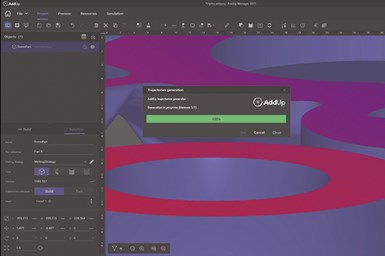
The AddUp Trajectory Generator computes about 22 million vectors in 17.3 seconds (8 Cores CPU @2.80 GHz).
AddUp’s latest version of its Trajectory Generator for its FormUp metal 3D printer features advanced algorithms that offer slicing and toolpathing performance, the company says. The program was developed in partnership with Inria (Institut national de recherche en sciences et technologies du numérique), the computer graphics experts behind IceSL, a highly efficient hybrid CPU-GPU slicer.
The AddUp Trajectory Generator is a fast slice and toolpath generator that offers smooth upskins and downskins to obtain superior part surface quality. The feature strengthens the existing list of operations available for visual strategy trees, which is a unique approach for AM strategies creation, according to the company.
The slicing and scanning trajectory computation speed is around 1,000 times the build speed of these trajectories, the company says. This performance is achieved through innovative algorithms and efficient parallelization on multi-core CPUs, which do not require specific vendor hardware. Also, slicing performance scales naturally with the number of CPU cores — from home laptops to many-core desktop CPUs. The slicer is designed to make the best use of the target platform capabilities.
Thanks to the visual strategy tree definition, users are given unlimited combinations of operations and parameters, while no programming skills are needed. With such a rapid learning curve, customers can be focused on production from day one, the company says. AddUp Trajectory Generator is included in the AddUp Manager 2021 manufacturing preparation software.
Related Content
-
Video: How Multimaterial Laser Powder Bed Fusion Works
Penn State University’s CIMP-3D is exploring applications of the Schaeffler Aerosint system for multimaterial 3D printing. During a recent visit, I got an introduction to this system.
-
3D Printed NASA Thrust Chamber Assembly Combines Two Metal Processes: The Cool Parts Show #71
Laser powder bed fusion and directed energy deposition combine for an integrated multimetal rocket propulsion system that will save cost and time for NASA. The Cool Parts Show visits NASA’s Marshall Space Flight Center.
-
Two 12-Laser AM Machines at Collins Aerospace: Here Is How They Are Being Used
With this additive manufacturing capacity, one room of the Collins Iowa facility performs the work previously requiring a supply chain. Production yield will nearly double, and lead times will be more than 80% shorter.

